
You can set up signal-based selling, also called signal-based lead generation, in 30 days with one sheet, one owner and one weekly review, and you do not need to buy a tool first. In week 1, choose three signals and a short list of accounts that fit your ideal customer. In week 2, build a signal log and decide where each signal will come from. In week 3, score fit and timing separately, name an owner for every signal and write the first message. In week 4, review what happened and cut what did not work. A signal is a recorded, dated, public event that suggests a company may need what you sell now. It suggests timing. It does not prove that the company wants to buy. This guide covers the setup. For the definition of signals and the types worth watching, read the signal-based lead generation guide first or alongside.
What are you setting up, and what does it replace?
You are setting up a small operating routine, not a new software system. The routine answers one question every week: which accounts that fit us did something recently that makes a conversation timely, and who is going to contact them?
Without it, outreach follows the list. Everyone on the list gets the same message on the same schedule, whether or not anything has changed at the company. With it, outreach follows the event. A company that just opened a role related to your service gets a message this week. A company that fits but has done nothing relevant stays on a watch list and gets attention later.
Three words need one clear meaning in your sheet before you start. Fit is how closely the company matches your written description of the ideal customer, and it changes slowly. A signal is a dated, public event at a fitting company that is close to the problem you solve, and signals change quickly. The third word, interpretation, is one sentence that says why this event matters to this company and your service. Without it, a message only repeats the news.
What do you need before day one?
Five things are worth gathering, and each prevents a common failure.
Start with your ideal customer, written in three lines: company size, industry, country and the problem you solve. If you cannot do it in three lines, write it first. A scorecard can help; see how to build a B2B ideal customer profile scorecard. Next, pick one owner, the person who keeps the sheet and runs the weekly review. Plan for roughly three hours a week at the start (an estimate; adjust it after week 2). A task shared by everyone is done by no one.
The third item is a shared sheet, and a plain spreadsheet is enough for the first month. The fourth is a list of 50 to 100 accounts that fit, small on purpose because you will check every signal by hand at first. The last is a person who will act: someone in sales or founder-led outreach who agrees to contact accounts within a set time when a signal appears.
Week 1: Which three signals should you start with?
Start with three signal types, not ten. Three is about what one owner can manage by hand.
To rank the candidates, ask three yes-or-no questions and begin with the ones that score three yes. Is the signal close to the problem you solve? A company hiring its first head of sales is closer to an outreach problem than one that won an award. Is it recent enough to matter? Choose a freshness window, for example 30 days, because an older event reads like a mass email with a date on it. And can you verify it from a public source? A job post, a company page or a press release can be checked. A guess cannot.
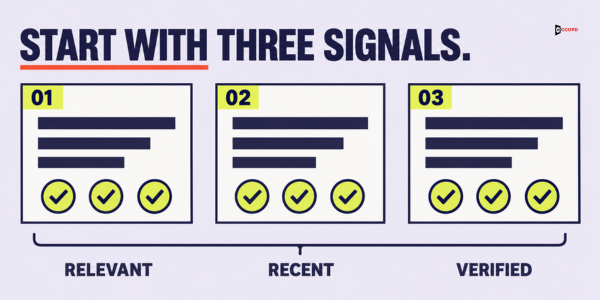
For each of the three you choose, fill in one definition card. The card keeps two people counting the same thing.
Here is a hiring signal as an invented example. The card name is "new role in the team our service supports". What counts is an open role posted in the last 30 days on the company's own careers page. A reposted role older than 30 days does not count, and neither does a role at a different company in the group. The source is the company careers page, and the freshness window runs 30 days from the post date. It matters because the company is investing in the area where we help, and the first action is one message to the likely owner of that area within the response time.
Week 1: How do you choose the account list?
Score each account on your three-line description: A for a clear fit, B for a partial fit, C for a poor fit. Only A accounts go into the first month. Fifty to a hundred A accounts is manageable, and it keeps you reaching out because of a signal at a company that fits, not because a name was available.
If you do not have a list yet, build one from a research workflow rather than a bulk purchase. The guide on building a clean B2B lead list shows how to do that without filling the sheet with bad records.
Week 2: What belongs in the signal log?
The log is the center of the system. One row is one signal at one account. Record the row before anyone acts on it, so you can later see which signals led to conversations.
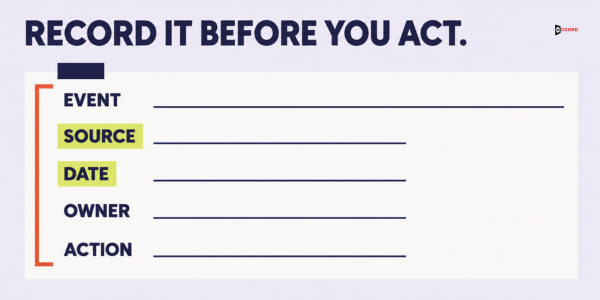
Twelve columns are enough. Begin with the date you saw the signal, the account name, the contact you plan to reach if you know who it is, and the signal type, which is one of your three. Add one plain sentence on what happened, the source link to the page where you saw it, and the event date, meaning the day the event happened and not the day you found it. Then record the fit score (A, B or C), the signal strength (1, 2 or 3, with the rules in the next sections), the owner who will act, and the action with its date. The last column is the outcome, and a short fixed set of values keeps it clean: no reply, reply, positive reply, meeting held or not relevant.
Four rules keep the log honest. Record the source and the event date, because a signal without a source cannot be checked, and one without an event date cannot be judged for freshness. Keep one row per account and signal; if the same company posts five similar roles, that is one signal, not five. Use public company information only, and do not record details from personal social accounts or private sources. Finally, keep the history and do not delete rows. After two or three months, the old rows show which signals work.
Week 2: Where do the signals come from?
Most small teams can find their first signals without paying for anything. Careers pages and job boards cover hiring signals, while company news or press pages show launches, openings and leadership changes. Company pages on professional networks add new hires and announcements. Your own website analytics can show visits by known accounts, where your privacy policy and local rules allow it. Your inbox and CRM hold replies, questions and requests, often the clearest signals of all. Free alerts, such as a search alert for an account's name plus a keyword, fill some gaps.
Start by hand and cap the effort at 30 minutes a day. Two weeks by hand teaches you which signals appear often, which are noise and which sources are reliable. Then you can judge whether a paid tool saves time by comparing it with what you found yourself.
A daily routine of 30 minutes can look like this: 10 minutes checking the careers pages and news pages of ten accounts from your A list, 10 minutes reading replies and site visits from named accounts, and 10 minutes writing the log rows and any messages. Rotate through the list so that every account is checked at least once a week. If an account shows a strong signal but you realize it does not fit, move it down a grade and write the reason, so the same mistake is not repeated next month.
Verify every signal. Open the source, read the date and confirm it is the right company. Automated alerts make mistakes, and a message built on a wrong signal is worse than no message. Rules about collecting and using data differ by country, so check the ones that apply to you. This guide is not legal advice.
Week 3: How do you score fit and signal separately?
Keep two scores and do not add them together. A high fit with a weak signal and a low fit with a strong signal are different situations, and a combined number hides the difference.
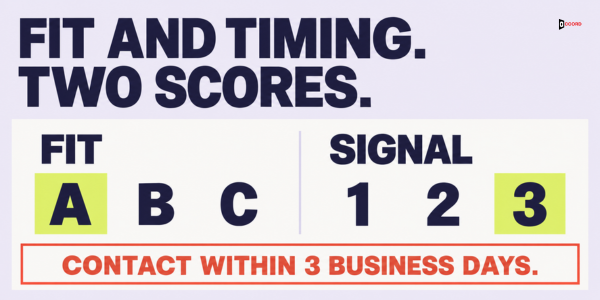
Signal strength runs from 1 to 3 on simple rules. A 3 is an event that is close to the problem you solve, happened in the last 14 days and comes from the company's own page. A 2 is related to the problem and happened in the last 30 days, or comes from a source other than the company. A 1 is only loosely related, or sits close to the end of your freshness window.
Then use a small table to decide the action. These timings are our proposals, not industry standards; adjust them to your capacity.
| Fit | Signal strength | Action |
|---|---|---|
| A | 3 | Contact within 3 business days |
| A | 2 | Contact within 5 business days |
| A | 1 | Watch; add a note and check again in 30 days |
| B | 3 | One light, relevant message |
| B or C | 1 or 2 | Do nothing; keep the record |
| C | Any | Do nothing |
Week 3: Who acts, and what should the first message say?
Every signal type needs one owner and one backup, written in the definition card. If the owner is away, the backup takes the signal. A signal that waits in the sheet for a week has already lost most of its value.
The first message has three lines:
- What you noticed. One public fact, stated plainly. "I saw that your team is hiring a customer success manager."
- Why it matters. One sentence for a company like theirs. "New hires often need a clear process for onboarding customers in the first few months."
- One easy question. "Is that something your team is working on this quarter?"
The wording above is an invented example. Mention one fact, not five. A message that lists everything you know about a person feels like surveillance, and one that only repeats the news gives no reason to answer. Do not claim the company has a problem. Offer a relevant observation and ask.

Week 4: How do you review and cut?
Hold a 20-minute review each week and read the log together. For each signal type, look at five numbers. Count how many signals were logged, and of those worth acting on, how many got a message inside the planned time. Then count the positive replies, meaning people who asked for details, times or a call, and the meetings held with a buyer who fits. The fifth number is how many signals turned out to be wrong or unrelated when someone replied.
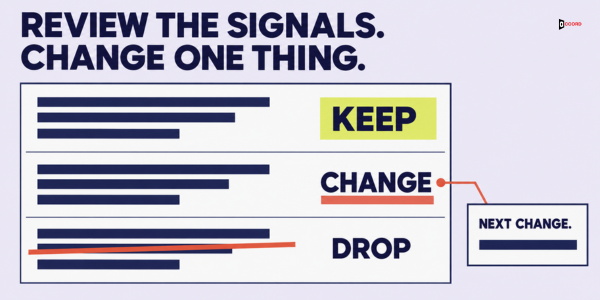
Be careful with small numbers. After 30 days you will have a few dozen signals, so one meeting more or less changes the rate a lot. Read the results as a direction. A reasonable rule, again our proposal, is to retire a signal type after two weekly reviews in which it produced no positive replies and at least ten messages were sent, and to keep a type that produces replies even when meetings are few.
A simple agenda for the 20 minutes
Spend the first 5 minutes on the five numbers. Spend the next 10 minutes reading five rows from the log together, two that worked and three that did not. Spend the last 5 minutes choosing one change for the coming week and writing it in the sheet with the date. One change at a time keeps the cause of any improvement clear.
Also read the replies. A reply that says "wrong person" points to a contact problem. One that says "not relevant" points to a signal that does not mean what you thought. And "not now" means a good fit with poor timing, so add a date to follow up.
What if one account shows several signals?
Log each signal in its own row, but contact the account once, with one message that opens with the strongest signal. Note the others in the log. If two different signal types appear at the same fitting account within 30 days, for example a new role and a new leader in the same team, raise the signal strength by one point, up to 3. That is a proposal and not a proven rule, and the weekly review will show whether stacked signals really produce more replies in your market. Never count one event twice: five similar job posts are one hiring signal.
How does this fit with your other outreach?
Keep signal-based outreach separate from bulk lists, because the two have different goals and measures. A bulk list is judged by meetings held per 100 people contacted. A signal list is judged by how many timely signals turned into conversations. Before any signal message goes out, run four quick checks: the person is still in the role, the account is not a customer or an open deal, nobody at your company contacted them in the last 60 days, and the address is valid. Do not put the same person into a bulk sequence on the same day. Cold outbound and email to existing customers are different systems, so keep this routine to cold and warm outreach and not to customer lifecycle email.
How much time will the setup take?
These hours are estimates for one owner and vary with your list and sources. Week 1 takes about 4 to 5 hours: writing the ideal customer, choosing three signals and scoring 50 to 100 accounts. Week 2 is similar, at 4 to 5 hours, to build the log, test each source and log the first signals. Week 3 needs 3 to 4 hours to score, assign owners, and write and send the first messages. Week 4 is the lightest, at 2 to 3 hours, for the review, the replies and the cuts.
If the owner cannot find the hours, shrink the list, not the routine. Thirty accounts watched properly teach more than 300 watched badly.
One more habit from the start: write down why you decided not to act. A short reason such as "poor fit", "signal too old" or "same event as last week" takes ten seconds. After a month those reasons show whether your rules are too strict or too loose.
How is signal-based selling different from personalization?
Personalization changes the words of a message: a first name, a company name, a line about the industry. Signal-based selling changes who you write to and when. A message built on a recent, relevant event reaches a company with a live reason to answer, and even a plain version of it can work, because the timing does the work that personalization is trying to fake. The two fit together: use the signal to choose the account and the moment, and use one specific line to show you understood why it matters.
Which tools help once the manual routine works?
Only add a tool when you can name the job it will do. Typical jobs are alerts for new job posts or news at your A accounts, a record of named accounts that visited your site, and a way to push signals into your CRM so the owner sees them in one place. Compare any tool on three questions: does it find signals you missed by hand, does it show the source and date of each one, and can you export the data if you leave? Many vendors promise intent scores. Treat a score as a hint, and check its source before you act on it.
What goes wrong in the first month?
Six mistakes show up often, and each has a simple fix. The most common is choosing too many signal types, because the owner cannot check them all; return to three. A close second is collecting signals without fit, so the sheet fills with interesting events at companies you cannot serve. Filter by fit first. Old signals cause trouble too, since an event from three months ago is not a reason to write today. Enforce the freshness window.
Then there is the sheet that everyone reads and nobody writes in, which happens when no owner is named for each signal type. Teams also buy a tool before the process is clear, and a paid alert system creates more signals than the team can use, so learn by hand first. The last mistake is wording. Calling a signal "intent" overstates it, because a hiring post shows activity, not a buying decision. Write "shows a relevant signal" in the sheet and not "ready to buy."
Imagine: one month at a fictional company
The details of this example are invented. Imagine a 25-person software company with one founder doing outreach. It writes its ideal customer in three lines and scores 90 accounts, of which 64 score A. It picks three signals: a new sales or marketing operations role, a new head of sales or marketing, and a recent expansion announcement.
By hand, in about 25 minutes a day, the founder logs 41 signals in four weeks. After the fit and strength rules, 18 are worth contacting: 11 at strength 3 and 7 at strength 2. The founder sends 18 messages and gets 5 replies, of which 3 are positive and 2 say the person is not the right contact. Two meetings are held.
At the week 4 review, the pattern is clear. Hiring roles produced 2 of the 3 positive replies. Expansion announcements produced 11 of the 41 signals, and the messages sent on them got no replies. The review shows that most of those announcements were only plans. The founder drops the expansion signal, keeps hiring and leadership changes, and adds a rule that a role must have been posted in the last 30 days. The numbers are tiny and prove nothing, but they point to where to spend the next 30 days.
Frequently asked questions
How many accounts do we need to start?
Fifty to a hundred accounts that fit is enough to learn how the routine works. A longer list adds work before you know which signals matter. You can widen the list after the first review.
Do we need a paid signal tool?
Not to start. Run the routine by hand for two to four weeks, then compare what a tool would have added. The tool helps when you know which signals matter, who acts on them and how fast. Without those, it only produces more rows to ignore.
How is this different from buying intent data?
Intent data from a vendor usually combines research behavior across many sites into a score. It can be useful, but it is probabilistic and hard to verify. The routine here uses events you can open, read and date yourself, and it keeps a human in charge of the decision to write.
Next step
If you want help picking your first three signals and building the log, book a 30-minute working session with the Accord team. Bring your three-line ideal customer and the 20 accounts you most want to reach, and use the time to draft your first definition cards.