
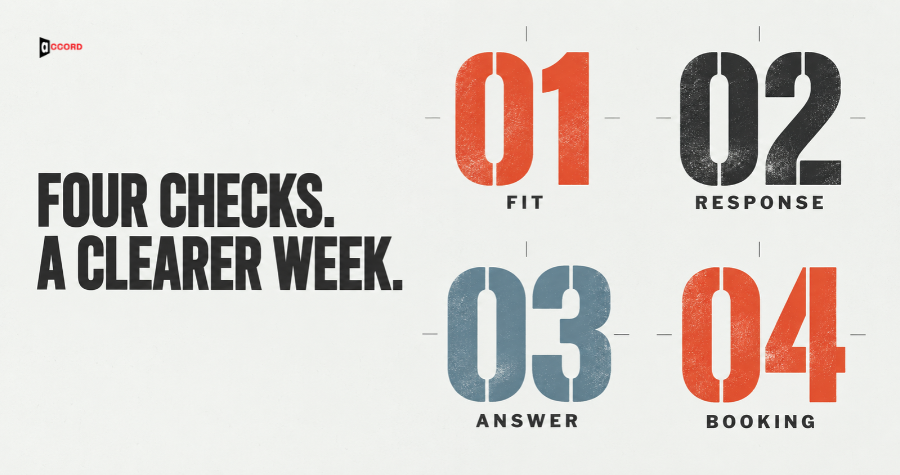
A weekly growth scorecard for outbound is one page of four checkpoints that show whether the people you first contact turn into booked meetings. In order, they ask whether you contacted the right people, whether they responded, whether a person answered fast, and whether a meeting was booked. Each has a plain test, a pass line, an owner and a fix, and the page takes about 20 minutes a week once set up. In this post "growth scorecard" is only a name for that page, which is a simple table, not software or a score out of 100.
The live guide to the weekly marketing and sales meeting agenda shows how to run the 25-minute meeting, and its sheet has six numbers and leaves most targets to you. This post narrows to four rates for outbound, with a pass line, an owner, a fix and a rule for tiny weekly numbers.
A note on the numbers. Every pass line and time limit in this post is a starting point from Accord, not an industry standard, so replace each with your own history after about eight weeks. The weekly rates are signals, not exact conversion rates, because they divide events counted in one week by people counted in the same week. The example is invented.
What is a weekly growth scorecard, and what does it leave out?
A weekly growth scorecard is a table you fill in once a week. Each row holds one rate, built from two counts of people, plus a pass line, an owner and a status, so you can see which part of the path to a booked meeting is weakest.
It leaves out opens, impressions and followers, which describe activity inside one channel. It also stops at the booked meeting, because held and qualified meetings and pipeline value arrive too slowly for a weekly read. They belong in a monthly count, like the one in the guide on why B2B channels do not add up to sales meetings. Long lists of B2B marketing metrics to track are hard to own, so this page has four rows.
Which four checkpoints belong on the page?
The four checkpoints follow one person from the first message to a calendar invite. They are metrics for a B2B lead generation funnel that you can collect by hand, with "top" as the people who passed and "bottom" as the group they came from.
| # | Checkpoint | Top count ÷ bottom count | Pass line (starting point) | Owner |
|---|---|---|---|---|
| 1 | Right people | Sampled first-contact people who match your written fit rule ÷ ten (or all, if fewer) | 8 of 10 or better | List owner |
| 2 | Responses | Positive-response people ÷ first-contact people | At or above your baseline from the first four weeks | Outreach owner |
| 3 | Fast answer | Positive-response people answered within the answer limit ÷ positive-response people whose limit has run out | Every one of them | Reply owner |
| 4 | Booked meetings | People with a booked meeting ÷ positive-response people | 1 booked for every 2, on the four-week total | Sales lead |
Each row ends in one of three statuses, except checkpoint 2 in its first four weeks, which is "baseline, not judged". On target means the four-week result meets the pass line. Read the cases means it falls short, so look at each person who missed before changing anything. Fix now means the cases show a cause you can act on, or the row fell short in two four-week totals in a row. Checkpoint 3 has its own fix now rule below. Work on the first row marked read the cases or fix now, because a later checkpoint cannot recover people an earlier one lost.
How do you count people, messages and meetings without mixing them?
Weekly scorecards often go wrong in the counting. Use one unit throughout: the person.
Define two terms in writing. A first-contact person is someone you message for the first time, on any channel, counted in the week of that message. A positive response comes from a first-contact person who asked for times, price, details or a call, in a reply, through a booking link or in a website form request. A form request from someone you did not contact goes on the inbound copy described in the FAQ. A reply that only names a colleague counts when the colleague answers. An out-of-office message and a request to stop do not count.
Messages go in a side column. One person who gets three emails is one person and three messages. Keep the message count for diagnosis, but never divide by it.

Meetings are counted under the person. One person who books one meeting is one booked meeting, even if they move it twice or bring a colleague. If two people from one company respond positively and one meeting is booked, only the person who booked counts, and the colleague stays a positive-response person with no booking. The case note, a line on why that person missed the line, says so.
Count each event in the week it happened. Use Monday to Sunday in one time zone. A positive response counts in the week it arrives, even if the first email went out earlier, and a meeting counts in the week it is booked. A weekly figure is therefore a signal, not a true conversion rate, and the four-week total softens the mismatch without removing it. For a true rate, follow one group of first-contact people for a fixed window, as the monthly cohort method in the channels guide does.
Keep tool numbers apart from counted numbers. A sending tool may report "replies" that include out-of-office messages and opt-outs, so count by reading them.
Checkpoint 1: Are you contacting the right people?
What it counts. The top count is the number of people, in a random sample of ten from this week's first-contact people, who match your written fit rule. The bottom count is ten. A fit rule is a short written description of who you want to reach, such as company size, industry, country and job title. If fewer than ten were contacted, check all of them.
The test. Divide the number of first-contact people by ten, round down, start at a random row and take every row at that step until you have ten, continuing from the top if needed. For 150 people, the step is 15. Compare each with the fit rule using what your CRM, the tool where you keep records of people and deals, already shows. If a record does not show enough to decide, count that person as not fitting.
Pass line. Eight of ten or better, which is 32 of 40 over four weeks, or 80%. Judge the status on the four-week total. One week at 7 of 10 is a reason to read the cases, not to panic, because ten records is a very small sample.
Owner. The person who builds or buys the lists.
Fix. Stop adding people from the weakest list source. Read the misfits for one pattern, such as an old list or wrong job titles, change the filter, and remove the misfits from the queue. With no written fit rule, write one first.
Checkpoint 2: Are the people you contact responding?
What it counts. The top count is the number of people who gave a positive response this week. The bottom count is the number of first-contact people this week. Do not use messages sent as the bottom.
The test. Read every reply received this week and mark each person as positive or not by hand, since a tool's "interested" label can be wrong. Then divide the four-week totals.
Pass line. There is no honest outside pass line, because response rates depend on your list and your offer. For the first four weeks the status is "baseline, not judged", and their combined rate becomes your baseline. If nobody has counted before, read the last four weeks of replies by hand. After that, a four-week rate at or above the baseline is on target. A lower one is read the cases, and fix now only when it is lower again in the next four-week total or the cases show a cause. The baseline is itself a small count, so keep it until you have eight clean weeks, then recalculate it.
Owner. The person who writes and sends the outreach.
Fix. Work through three causes in order. First, check checkpoint 1 for the same weeks, because a bad list lowers this rate first. Second, read the message: one reason for writing and one simple ask is easier to answer than a long email. Third, send a test to a personal Gmail or Outlook mailbox and see whether it lands in the inbox or the spam folder.
Checkpoint 3: Does a person answer each positive response in time?
What it counts. The top count is the number of positive-response people whose first human answer came within your answer limit. The bottom count is the number of positive-response people whose limit had already run out when you counted. A first human answer is a reply written by a named person for this reader, so an automatic acknowledgement does not count. A person who books through your link counts as answered in time.
A person counts in checkpoint 2 in the week the response arrived, and in checkpoint 3 once the limit has run out, which may be the week after. Over four weeks both rows cover the same people, except anyone still waiting, who joins the next count.
The test. For each person you need two times, both visible in the email thread: when the response arrived and when a person answered. Compare the gap with the answer limit, in the owner's local working hours, with the time zone written down.
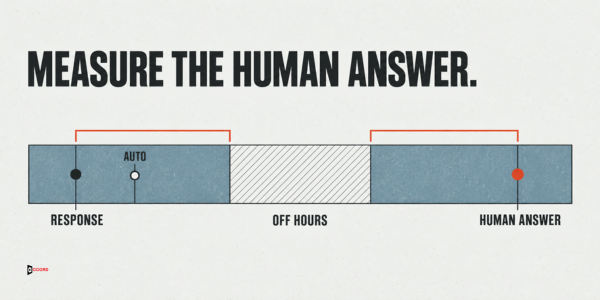
Pass line. Every one of them, judged person by person, not as a percentage. One miss in four weeks is a case to read the same day. Fix now applies when the four-week total has two or more misses and also more than one miss in twenty responses. The speed-to-lead guide on follow-up by trigger proposes one business hour for a positive reply to cold email, and the reply guide linked below advises the same business day. Pick one limit your team can meet.
Owner. The person who owns the inbox where responses land, with one named backup.
Fix. Find out where the late responses sat. Common causes are a sending tool's inbox checked once a day, a shared mailbox with no owner, and a person on leave. Send positive responses to one inbox with a named watcher, a phone alert and a named backup.
Checkpoint 4: Do positive responses turn into booked meetings?
What it counts. The top count is the number of people who agreed to a meeting this week, with a date and time on the calendar. The bottom count is the number of positive-response people this week. A person who books and later cancels still counts as booked, because held meetings are a monthly question. One week can show more than 100%, since someone who responded last week may book this week, so judge the four-week total.
The test. For each positive-response person, check the calendar for a meeting with a date and time that both sides accepted. Then divide the four-week totals.
Pass line. At least one booked meeting for every two positive-response people, on the four-week total. That is 50%.
Owner. The sales lead, or whoever holds the calendar.
Fix. Do not start with the percentage. List every positive-response person who did not book and write one line on why. Usual reasons are that no times were offered, that the thread ran long, that the person waited too long, or that the person said "not now". The guide on how to respond to a positive cold email reply and book the call covers the answer, the offer of times and the follow-up. Its monthly reply-to-meeting rate is the cohort version of this checkpoint.
How do you run the scorecard in about 20 minutes each week?
Run it every Monday morning, before the weekly meeting. One person, the keeper, fills in the page and the four owners act on it.
- Close the week (2 minutes). Update the CRM and sending tool for Monday to Sunday.
- Pull the raw counts (5 minutes). First-contact people, positive responses, answers in time and booked meetings, from the CRM or by reading the inbox and calendar.
- Check ten records (5 minutes). Pick ten first-contact people at random and compare them with the fit rule.
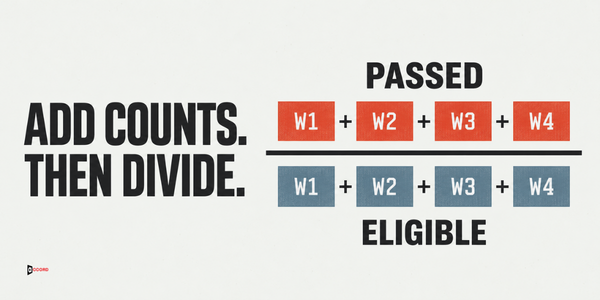
- Enter the counts (3 minutes). Copy the seven-column table from the example below into a sheet, where Passed is the top count and Eligible is the bottom count. Keep each week's counts on a second tab that adds up the four-week totals, and do not average four weekly percentages.
- Set each status (3 minutes). Mark each row on target, read the cases, or fix now, with one sentence for any row that is not on target.
- Send the page (1 minute). Send it to the four owners. A fix now row carries a name and a date.
That is 19 minutes. The first week takes one to two hours, because you write the fit rule and the answer limit. If a count is missing, write "not known" in the cell, never a guess.
What should you do with small numbers?
Weekly counts for many small B2B teams are tiny. A week with 3 positive responses and 2 booked meetings is normal, and a move from 3 to 4 means little.
Read four weeks together. Add the last four weeks of top counts, add the last four weeks of bottom counts, and divide. This also evens out the delay between a first message and a reply.
Methodology note: the margin of error. Use it as a rough range, never as a pass or fail test. The margin of error is how far a rate can move by chance alone. A rough way to find it is two times the square root of (rate times (1 minus rate) divided by people), which in a spreadsheet is =2*SQRT(rate*(1-rate)/people), with the rate as a decimal such as 0.5 and the bottom count of that row as "people". The NIST Engineering Statistics Handbook calls this the most frequently used expression, says it may not be accurate enough for very small samples, and offers other methods. We use 2, a rounding of the 95% value 1.96. For 5 of 12, the rate is 0.417 and the margin is 0.285, or 28.5 points. At a rate of 50%, 12 people give a margin of about 29 points, 25 people about 20 and 100 people about 10.
The formula treats the people as one fixed group, which weekly counts only roughly are. It also shows a margin of zero when every person passes, so 12 of 12 does not mean you can be sure, only that nobody has failed yet.
Read the people when the bottom count is small. If the four-week bottom count is under about 25, the margin can be 20 points or more, so the percentage is only a prompt. Read each person who did not pass and write the reason. Change your process when the cases show a cause, or when a row other than checkpoint 3 falls short in two four-week totals in a row, not because of one week.
Imagine: eight weeks for a 15-person software company
This example is invented. Imagine a 15-person company that sells scheduling software to home-service businesses and contacts new people by email. It has a written fit rule and a one-business-hour answer limit. The table is the scorecard itself, with four-week totals. Assume every booking came from someone in the same four-week group of positive-response people.
| Checkpoint | Passed | Eligible | Four-week result | Status | Owner | Next action |
|---|---|---|---|---|---|---|
| Weeks 1 to 4 (sample) | ||||||
| 1 Right people | 32 | 40 | 80% | On target | List owner | None |
| 2 Responses | 12 | 600 | 2.0% | Baseline, not judged | Outreach owner | Keep as the baseline |
| 3 Fast answer | 9 | 12 | 75%, 3 misses | Fix now | Reply owner | One shared inbox, phone alert, backup |
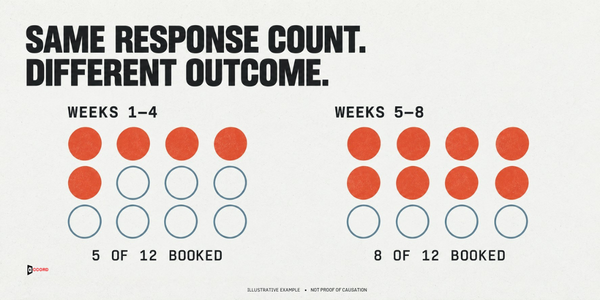
| 4 Booked meetings | 5 | 12 | 42% | Read the cases | Sales lead | Read the 7 who did not book |
| Weeks 5 to 8 (sample) | ||||||
| 1 Right people | 34 | 40 | 85% | On target | List owner | None |
| 2 Responses | 12 | 600 | 2.0% | On target | Outreach owner | None |
| 3 Fast answer | 11 | 12 | 92%, 1 miss | Read the cases | Reply owner | Cover the backup's leave |
| 4 Booked meetings | 8 | 12 | 67% | On target | Sales lead | None |
Weeks 1 to 4. Week 2 had 7 of 10 fit records, and the three misfits all came from one old list. Week 2 alone shows 1.25% positive responses, but that is 2 of 160 first-contact people, so the keeper waits for the four-week total. Checkpoint 3 is fix now because responses land in the sending tool's inbox, which one person opens daily. Checkpoint 4 is below the 50% line, but with only 12 people its range runs from about 13% to 70%, so the company reads the 7 people who did not book. Three had waited past the limit and went quiet, three went quiet after information, and one said "not now". Checkpoint 3 is the first row that is not on target, so its owner acts.
Weeks 5 to 8. The one miss on checkpoint 3, in week 8, is a case to read: the backup was on leave too. Of the 4 who did not book, one had waited too long, two went quiet after information and one said "not now".
So 5 booked meetings from 12 positive-response people became 8 from 12. With only 12 people each time, part of that gap could be luck. The better evidence is in the cases: three people waited too long in the first four weeks, and one in the next four. Real results will differ.
Frequently asked questions
How many checkpoints should a weekly growth scorecard have?
Only as many as you can own and act on. This guide uses four, one for each step from first contact to a booked meeting. Add a fifth only with a named owner and fix.
Is a weekly growth scorecard only for cold email?
No. It starts at any first contact you send, whether an email, a LinkedIn message or a call. For people who ask first, such as through a website form, run a separate inbound copy that begins at checkpoint 3, because they are already positive-response people.
Is there a sales scorecard template I can copy?
Yes. The table in the example above is the scorecard. Copy its seven columns into a spreadsheet, where Passed is the top count and Eligible is the bottom count. Keep the weekly counts on a second tab that feeds the four-week totals, and let the sheet divide them. It does not track individual reps or daily activity.
What is a good positive response rate for a B2B scorecard?
No honest single figure exists, because published positive response rates depend on the list, the offer and how the number was counted. Record your own rate for four weeks as the baseline.
How do we read a week with only two or three positive responses?
Do not read a percentage from it. Read the people: check whether each was answered in time and whether each booked, and write down why not.
How many weeks of data do we need before we trust a rate?
There is no safe number. Four weeks gives a first read, and it helps only when about 25 or more people sit in the bottom count. Below that, the margin of error can reach 20 points, so read each case or extend the window to eight weeks. Even then, a rate is a signal, not proof.
What if the CRM or sending tool cannot give us a count?
Write "not known" in the cell with an owner and a date, and count by hand meanwhile. Do not copy a tool figure onto the page until you know how the tool defines it.
Next step
For a second pair of eyes on your first scorecard, book a 30-minute working session with the Accord team. Bring your last four weeks of counts and we will write the fit rule, answer limit and first fix together. Accord sells outbound, email and lead-generation services, so we have an interest in this topic, but the scorecard works the same way with or without a provider.