Can predictive intent really help emails avoid spam?
Yes. As of March 2026, Google's own help documentation and Google Research both show that Gmail uses past user actions and per-user prediction models to decide which emails look important, while Google's anti-spam systems block more than 99.9% of spam, phishing, and malware from reaching inboxes.
If you run email for a business, that matters more than it may seem at first glance. The old way was simple: send a message, hope it lands, then blame the subject line when it does not. The newer reality is different. Inbox systems now judge identity, behavior, engagement, message context, and complaint rates together.
The result is simple. Better signals lead to better placement. Worse signals quietly push you toward spam. That is why a stronger email marketing strategy now depends on trust signals just as much as copy.
This guide explains how Priority Inbox works, what Predictive Email Intent actually means, why legitimate messages still go to spam, and how a modern email marketing service strategy supports better inbox placement and healthier long-term deliverability.
Table of Contents
- What Priority Inbox to Avoid Spam Actually Means
- What Is Predictive Email Intent?
- How Gmail Decides Which Emails Look Important
- How Spam Filters Really Work in 2026
- Email Deliverability Strategy for Brands That Want the Inbox
- Inbox Placement Optimization and Why It Beats Vanity Metrics
- Email Spam Avoidance Starts Before You Write the Subject Line
- What Decision-Makers Should Do Now
- FAQs
- In Short
What Priority Inbox to Avoid Spam Actually Means

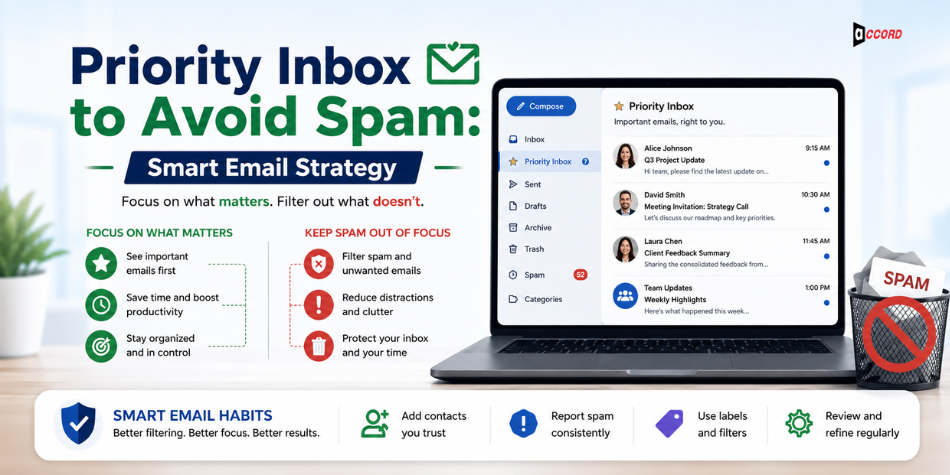
Priority Inbox is Gmail's way of deciding which messages appear more important for a specific user. It does not replace spam filtering, but it works alongside Gmail's filtering and ranking systems by using past actions, message context, and sender signals to decide what deserves attention first.
A lot of people confuse delivery with visibility. That confusion causes real damage. An email can be accepted by a mail server and still fail where it counts. It may land in spam, Promotions, or simply look unimportant enough to be ignored.
That difference is the heart of this topic. If your goal is Priority Inbox to Avoid Spam, you are really talking about the intersection of relevance and trust. Gmail's Priority Inbox is about user-level importance. Spam filtering is about risk, legitimacy, and quality. Inbox placement improves when both sides work together.
What Is Predictive Email Intent?
Predictive Email Intent is the practice of using behavioral and contextual signals to estimate what kind of message a recipient is likely to value, ignore, or reject.
In Gmail's case, this appears in how the system predicts whether a user will act on a message and how it uses past actions to mark importance. Google Research described Priority Inbox as ranking mail by the probability that a user will perform an action on it.
The model is not asking whether an email is good in general. It is asking whether a specific person is likely to do something with that message. That is why predictive email marketing works best when it respects actual user interest instead of forcing volume.
How Gmail Decides Which Emails Look Important

Gmail uses a mix of signals, including past user actions, thread activity, message content, sender trust, and other patterns, to predict importance. Users can also disable the use of past actions in importance settings, which confirms that behavioral learning is built into the feature.
Start with behavior. Opens, replies, stars, and recurring interaction patterns all appear to feed this ranking. Then there is thread context. In real inboxes, ongoing conversations matter. A reply inside an active thread usually has more value than a random new blast.
Content matters too, but not in the shallow "use this keyword" sense that weak email advice still pushes. A message with a clear purpose, relevant timing, and recognizable context may look more valuable than a message full of vague hype. That is one reason many teams dealing with low response rates need to understand why emails stop getting replies in 2026.
Frequency also matters. Too much mail from the same sender can quietly reduce urgency. If someone emails you ten times a day, the eleventh message rarely feels special. Inbox systems appear to make similar judgments. That is one of the overlooked factors affecting email deliverability.
How Spam Filters Really Work in 2026

Modern spam systems do not rely on one rule. They combine identity checks, sender reputation, user complaints, engagement, volume patterns, and content analysis to decide whether a message belongs in the inbox, spam folder, or another tab.
The first layer is authentication. SPF, DKIM, and DMARC verify whether a sender is allowed to send on behalf of a domain and tell receivers what to do when checks fail. The second layer is reputation. Google's sender guidance makes this practical: senders should keep spam rates below 0.1% and avoid reaching 0.3% or higher because complaint rates directly affect inbox delivery.
The third layer is engagement. If recipients open, reply, save, and continue reading, your messages look useful. If they ignore, delete, or mark them as spam, the system gets a different story. This is where sender reputation is shaped over time, not just by DNS settings, but by human behavior.
The fourth layer is content and structure. Pre-send testing can catch authentication problems, blocklist concerns, and spam-triggering patterns before the message goes out. That is a smarter way to think about optimization than chasing gimmicks after performance drops.
Email Deliverability Strategy for Brands That Want the Inbox
A modern Email Deliverability Strategy combines technical setup, sender reputation management, list quality, sending cadence, and message relevance. It is not one fix. It is an operating system for trust.
A practical framework looks like this:
- Technical trust: set up SPF, DKIM, and DMARC correctly, align domains, and monitor failures.
- Behavioral trust: send to people who expect your emails, remove cold segments that never engage, and avoid sudden volume jumps.
- Content trust: write like a real person, match the promise in the subject line, and make the message worth opening.
- Operational trust: watch complaint rate, bounce rate, inbox placement, and list hygiene every week.
If you want to improve email deliverability, the biggest wins usually come from cleaner sending behavior and better audience qualification, not from adding more urgency words. That aligns closely with the advice in the live post on B2B email deliverability checklist improvements for 2026.
A second blind spot is mixing email streams. Transactional mail, lifecycle mail, newsletters, and aggressive outbound sequences should not always share the same reputation path. That is one reason deliverability teams increasingly separate cold, transactional, and marketing traffic.
Accord Tech Solutions Insight Box
For teams evaluating email deliverability support, the useful lens is operational maturity, not flashy promises. A sensible review should start with authentication and domain alignment, then move into complaint sources, low-engagement segments, inbox placement, and one shared dashboard across marketing, CRM, and IT.
Inbox Placement Optimization and Why It Beats Vanity MetricsInbox Placement Optimization means increasing the percentage of emails that land in the inbox rather than spam or hidden tabs. It is more useful than raw delivery stats because accepted mail is not the same as seen mail.
A campaign can show "delivered" in your ESP and still fail commercially. Teams celebrate the send, but the audience never really sees the message. That is why inbox placement rate is one of the most useful ways to measure real deliverability.
The metrics worth tracking are the ones that tell the truth:
- Inbox placement rate by provider
- Complaint rate and unsubscribe trend
- Bounce rate and list decay
- Reply rate, read depth, and repeat engagement
- Authentication pass rates and domain health
This is the foundation of any serious inbox placement strategy. It also supports improving inbox placement rate over time because you stop guessing and start measuring the signals mailbox providers are likely to care about.
Email Spam Avoidance Starts Before You Write the Subject Line
Email Spam Avoidance is not about tricking the filter. It is about proving legitimacy, reducing friction, and sending messages that recipients actually want. That requires technical compliance, clean lists, sensible volume, and relevant content.
When people ask why emails go to spam, the honest answer is usually some mix of poor authentication, weak engagement, rising complaint rates, stale lists, misleading copy, inconsistent sending behavior, or damaged reputation. Sometimes it is several of those at once.
The next question is just as common: how do you reach the primary inbox? You cannot force it. You can only earn the signals that make primary placement more likely for the right recipients. That means sending useful email to people who recognize you, keeping volume stable, making unsubscribe easy, and respecting consent.
Common Misconceptions
A common myth says good copy fixes everything. It does not. Great copy sent from a damaged domain still struggles. Another myth says Promotions is basically spam. That is wrong. For many marketing emails, Promotions is normal. It is separate from the spam folder and should not be treated as proof that a campaign failed.
A third myth is that more volume creates more opportunity. In practice, careless scale often lowers trust. More mail without stronger relevance usually means more complaints and worse delivery.
A Practical Example
Imagine a mid-market SaaS company sending product alerts, trial nurture emails, and cold outbound follow-ups from one domain. Nothing looks obviously broken. Yet quarter after quarter, response rates drift down, and sales says the inbox is dead.
The issue may not be one dramatic failure. It could be accumulated friction. Cold prospects ignore the outbound. Some mark it as spam. Marketing keeps mailing older segments that have not engaged in months. Product alerts share the same domain reputation path.
Now picture the fix. The team separates streams, tightens list hygiene, verifies SPF, DKIM, and DMARC, slows new domain ramp-up, cuts low-engagement segments, and rewrites nurture emails around actual user intent. Over the next few cycles, complaint pressure falls, replies improve, and inbox placement stabilizes.
What Decision-Makers Should Do Now
If you lead marketing, review audience quality before creative quality. Segment by actual engagement. Remove dead weight. Relevance is cheaper than resuscitation.
If you own CRM or lifecycle email, map every sending stream and check whether your inbox placement strategy treats transactional, marketing, and outbound mail differently. If it does not, there is a decent chance you are carrying hidden reputation risk.
If you work in IT or operations, verify authentication alignment and reporting. SPF, DKIM, and DMARC are not optional hygiene anymore. They are baseline trust infrastructure. Teams that want stronger long-term engagement should also pay attention to newer automation patterns such as those covered in the AI email marketing guide for 2026 success.
Future implications are straightforward. Priority systems will likely become even more personal. That means generic blasting gets weaker over time, while high-fit sending becomes more valuable. A small list that opens, replies, and trusts you can outperform a giant list that barely remembers who you are.
FAQs
In Short
The old approach to email was volume first. The newer approach is signal first. That shift is the real advantage here. Instead of asking how to send more, the better question is how to send mail that Gmail can trust and recipients actually want.
When you align Predictive Email Intent, deliverability strategy, inbox placement optimization, and spam avoidance, more important mail reaches the inbox and less energy gets wasted on messages that never had a fair chance.
From a brand capability standpoint, this is where a specialist partner such as Accord Tech Solutions fits naturally: not as a shortcut, but as a structured way to connect sender setup, content relevance, and long-term inbox health. For teams looking to benchmark their current setup, the live guide on email marketing best practices for 2026 is a strong companion read.