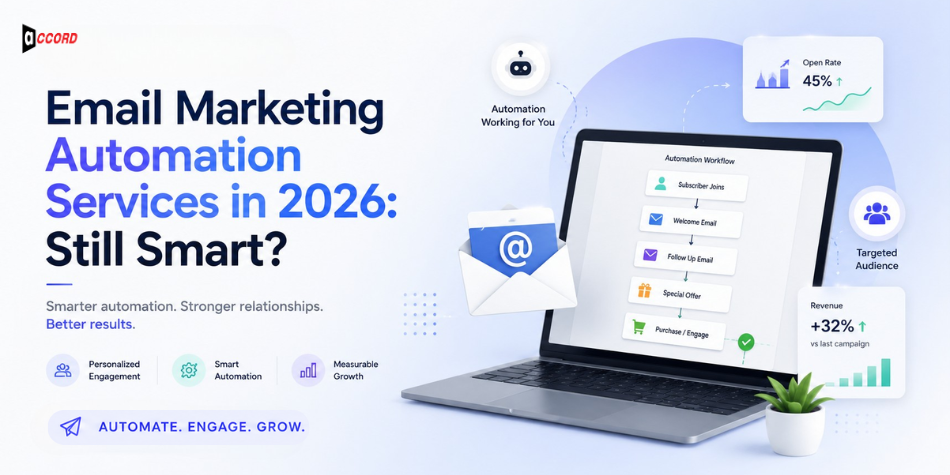
More than before.
Brands now deal with crowded inboxes, stricter sending rules, rising customer acquisition costs, and people who expect more personal, relevant messages instead of generic ones.
That's why email marketing automation services matter so much right now.
The old way was simple but not very effective. You'd send the same message to everyone and just hope a few people would respond.
Now things work differently. Businesses use data, group their audience, set up automated journeys, and adjust messages based on user behavior.
Because of this, engagement improves, revenue becomes more efficient, and there's far less wasted effort.
Table of Contents
- Key Takeaways
- Quick Answer
- What is Email Marketing Automation Services?
- Why Email Marketing Agency in USA Matters More in 2026
- Email Marketing Services vs Traditional Batch Sending
- How Automated Email Campaigns Actually Work
- What Does AI Email Marketing Automation Really Improve?
- Why Email List Segmentation and CRM Automation Drive Revenue
- Why Deliverability and Inbox Placement Optimization Are Not Optional
- What to Look for in Email Marketing Software and Agency Execution
- Common Misconceptions
- Best Email Marketing Strategies 2026 for U.S. Brands
- When to Bring in an Email Marketing Agency
- Conclusion
- FAQs
Key takeaways
Email marketing automation services work best when strategy, data, content, and deliverability are managed together.
AI email marketing automation is useful when it improves timing, segmentation, copy testing, and prediction, not when it replaces judgment.
Inbox placement optimization is now a core business issue, not a technical side task, because Gmail requires sender authentication and bulk sender compliance.
Email list segmentation and behavioral email targeting usually outperform one-size-fits-all campaigns because relevance drives opens, clicks, and conversions.
A strong email marketing agency in USA should handle workflow design, reporting, CRM integration, and deliverability governance, not just template design.
Public content from Accord Tech Solutions shows a service focus on targeting, campaign management, analytics, automation, and AI-assisted personalization.
Quick answer
Email marketing automation services help businesses send the right message to the right person at the right time using workflows, triggers, segmentation, CRM data, and performance tracking.
In the USA, the real differentiator is not just automation. It is whether those systems also support compliance, deliverability, revenue attribution, and ongoing optimization.
What is email marketing automation services?
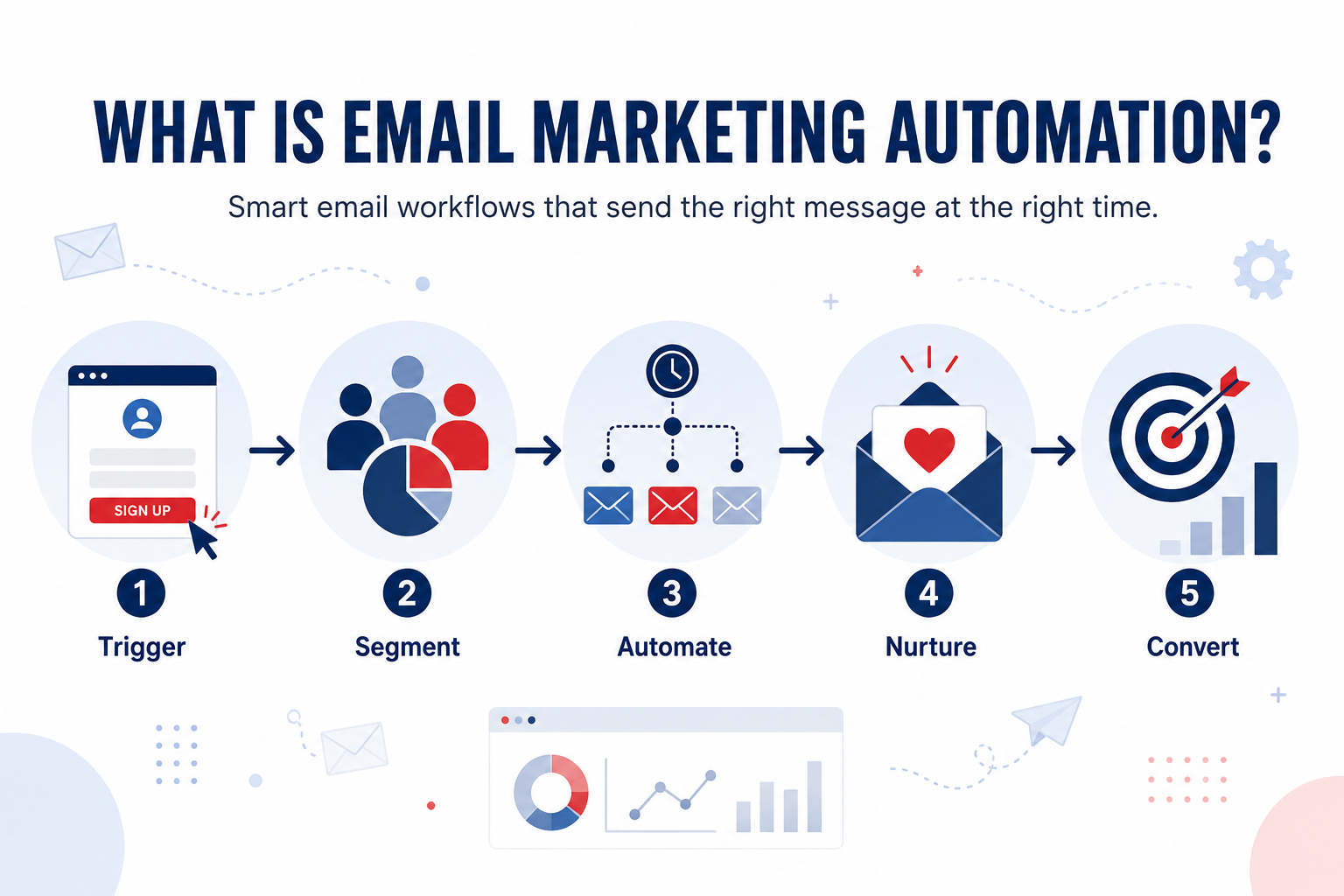
At a practical level, email marketing automation services means building and managing systems that send emails based on timing, customer behavior, lifecycle stage, or CRM events instead of sending each campaign manually.
That can include welcome series, lead nurturing, abandoned cart reminders, re-engagement flows, onboarding messages, upsell sequences, and retention programs.
HubSpot describes email automation as a way to match use case, team size, and integrations while using AI where it actually improves execution.
This is where many businesses get confused. They think email marketing automation is just scheduling a newsletter. It is not.
A good automation program is closer to a system of communication logic. Someone downloads a guide, visits a pricing page, ignores two messages, books a demo, or becomes inactive for 60 days. Each action can change what happens next. For a practical guide to building this kind of system from scratch, the guide on email marketing automation and how to implement it covers the setup process step by step.
That is also why businesses still buy email marketing services instead of relying only on in-house tools. Software gives you buttons. Strategy decides what should happen when a buyer hesitates, compares options, or comes back after months of silence.
Why email marketing agency in USA matters more in 2026
The U.S. market is crowded, expensive, and fast-moving. Paid acquisition costs are rarely going down for long. Organic reach is unstable.
Meanwhile, buyers expect timely, relevant messages and quick follow-up. In that environment, a capable email marketing agency in USA can help connect customer intent with revenue without depending entirely on ad spend.
There is also a compliance and deliverability angle. Google's sender guidance requires SPF and DKIM authentication, recommends aligned authentication practices, and warns that missing requirements can cause email to land in spam or be rejected.
For bulk senders, one-click unsubscribe and spam-rate discipline matter too. Google's FAQ says spam rates should stay below 0.1% and should never reach 0.3% or higher.
That may sound technical. It is. But it is also commercial. If your messages do not reach the inbox, your campaigns do not really exist. The B2B email deliverability checklist for 2026 covers the exact authentication and compliance steps that determine whether your emails land in the inbox or the spam folder.
Email marketing services vs traditional batch sending
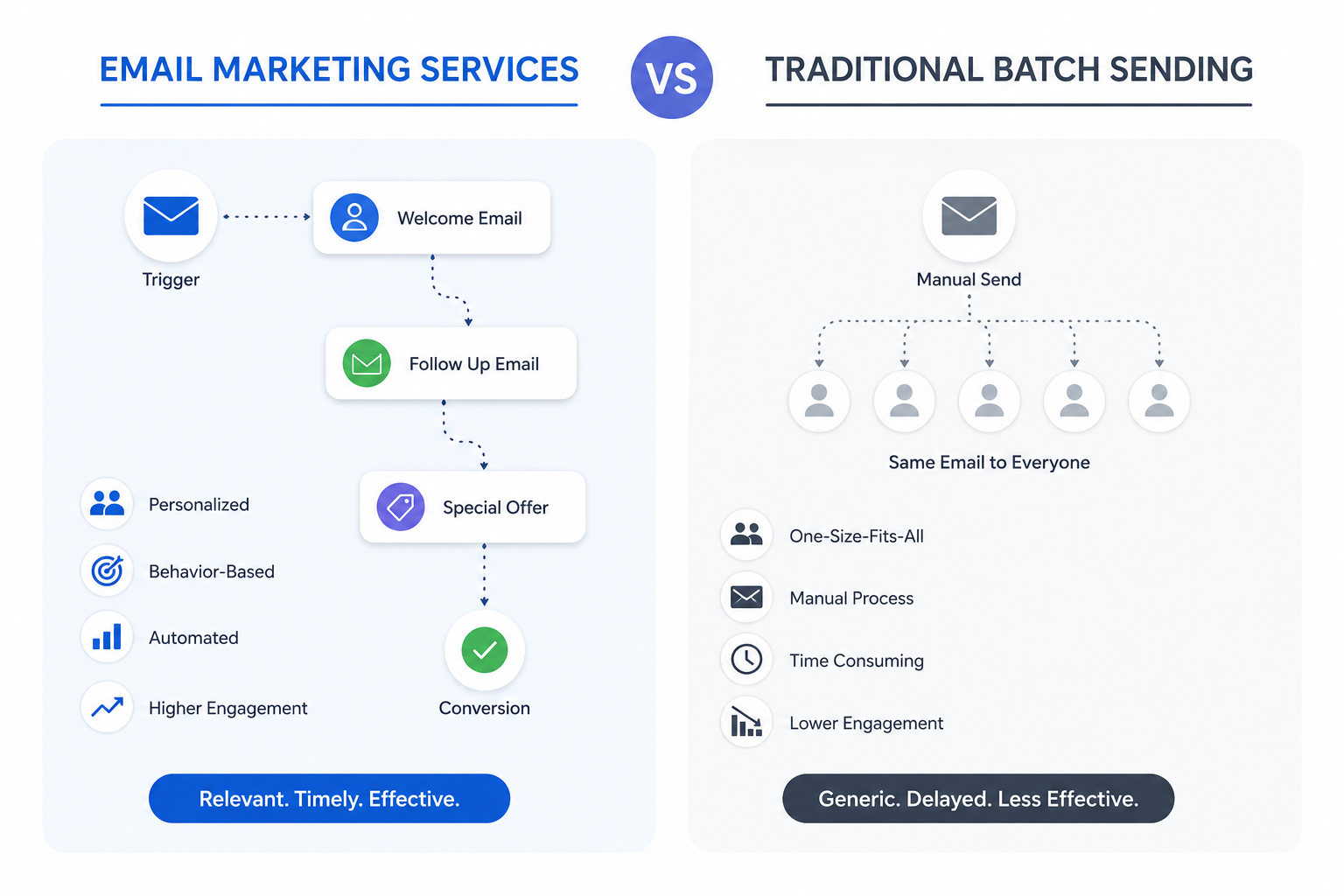
Traditional sending looks efficient on the surface. One list. One email. One send date. Done.
But it often hides waste. New leads get the same message as warm prospects. Existing customers see beginner-level offers. Inactive contacts keep receiving campaigns they no longer want.
Open rates become misleading, click rates flatten, and the team starts blaming the creative when the real problem is structure.
A modern email marketing agency usually takes a different route. It breaks the list into meaningful segments, maps customer journeys, connects form fills and CRM fields, builds triggers, tests subject lines and send times, and tracks not only clicks but business outcomes.
Accord Tech Solutions' public pages and blogs frame their own email work around targeted campaigns, automation, performance tracking, list growth, and AI-supported personalization, which is the right general direction for this service category. For a clear view of what the best practices look like in practice, the guide on the best email marketing practices for 2026 is worth reading alongside this one.
How automated email campaigns actually work
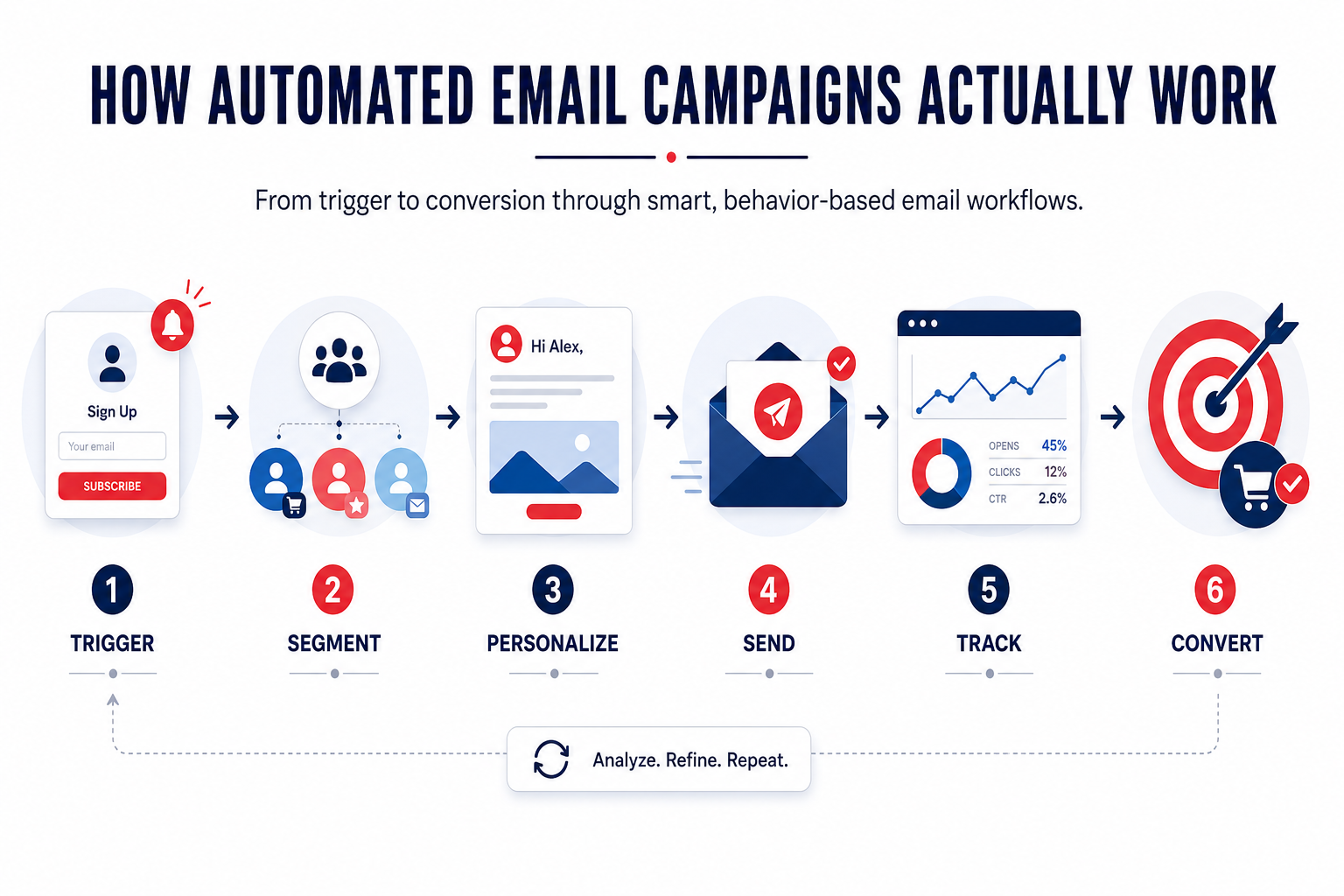
That trigger may come from a signup form, a purchase, a page visit, a webinar registration, a CRM stage change, or a period of inactivity.
Once triggered, the workflow decides which message to send, when to send it, and what condition should move the person to the next step.
This is where automated email campaigns, drip email campaigns, and smart email sequencing start to overlap. They are related, but not identical.
Automated email campaigns
These are rule-based campaigns triggered by events or schedules. A welcome email after signup is the classic example.
Drip email campaigns
These are time-based sequences. Someone enters the flow today and receives message two after two days, message three after five days, and so on.
Smart email sequencing
This is more adaptive. The path changes based on engagement, lifecycle stage, or CRM context. A person who clicks pricing may jump to a sales-assist path. Someone who never opens may move to re-engagement or suppression.
That last piece is where AI email marketing becomes useful. HubSpot notes that AI can analyze past performance, optimize send time, improve subject lines, generate content support, clean lists, and trigger workflows after actions.
Their recent research also found that 54% of marketers saved 1 to 5 hours a week with AI in email marketing, while 31% saved 6 to 10 hours.
What does AI email marketing automation really improve?
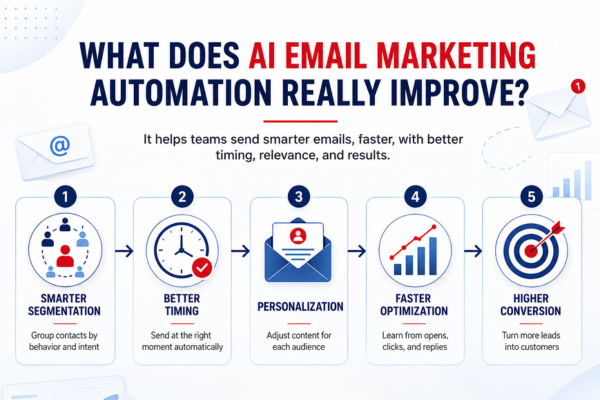
A lot of articles talk about AI as if it is magic. It is not. It is pattern recognition plus prediction plus speed.
Used well, AI email marketing automation can support:
better send-time decisions
faster subject line testing
content drafting support
audience scoring
suppression of low-intent contacts
product or content recommendations
likely-converter identification
HubSpot also reports that conversion rate was the top KPI improved by AI in email marketing, followed by click-through rate.
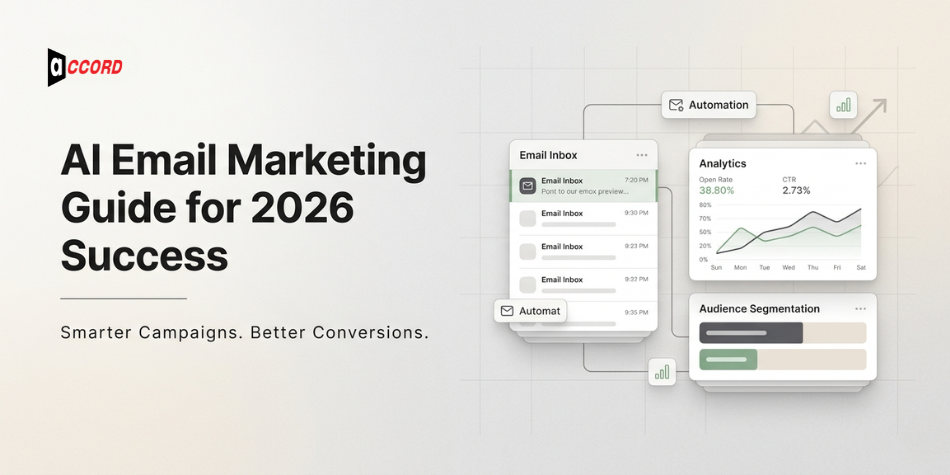
That does not mean AI guarantees results. It suggests that good data and faster iteration often improve campaign performance. For a full picture of how AI is changing email outcomes in 2026, the 2026 AI email marketing guide covers the mechanics and real-world application in detail.
This is also where predictive email campaigns enter the picture. A predictive workflow may estimate which subscribers are most likely to buy, churn, or respond to a specific offer. Instead of blasting everyone, it prioritizes the segments with the strongest probability of action.
And then there is behavioral email targeting. Mailchimp explains that event data can be used to segment audiences and send targeted content based on actions outside the email itself. In plain English, the system can react to what people do, not just who they are on paper.
Why email list segmentation and CRM automation drive revenue
A generic list is easy to build and hard to monetize.
Segmentation changes that. Mailchimp notes that segmentation divides subscribers into groups based on actions, behavior, interests, age, location, and other factors, making campaigns more personalized and more likely to convert.
Mailchimp also claims marketers can see higher open rates with segmentation.
Now add CRM automation. This is where marketing and sales stop acting like separate departments. Lead status, source, product interest, lifecycle stage, and opportunity data can all influence the next email.
A prospect who already booked a demo should not get the same "learn more" email as someone who only downloaded a checklist. That sounds obvious, but many companies still get this wrong.
One useful mental model is this:
Traffic → Capture → Segment → Nurture → Score → Hand off → Convert → Retain
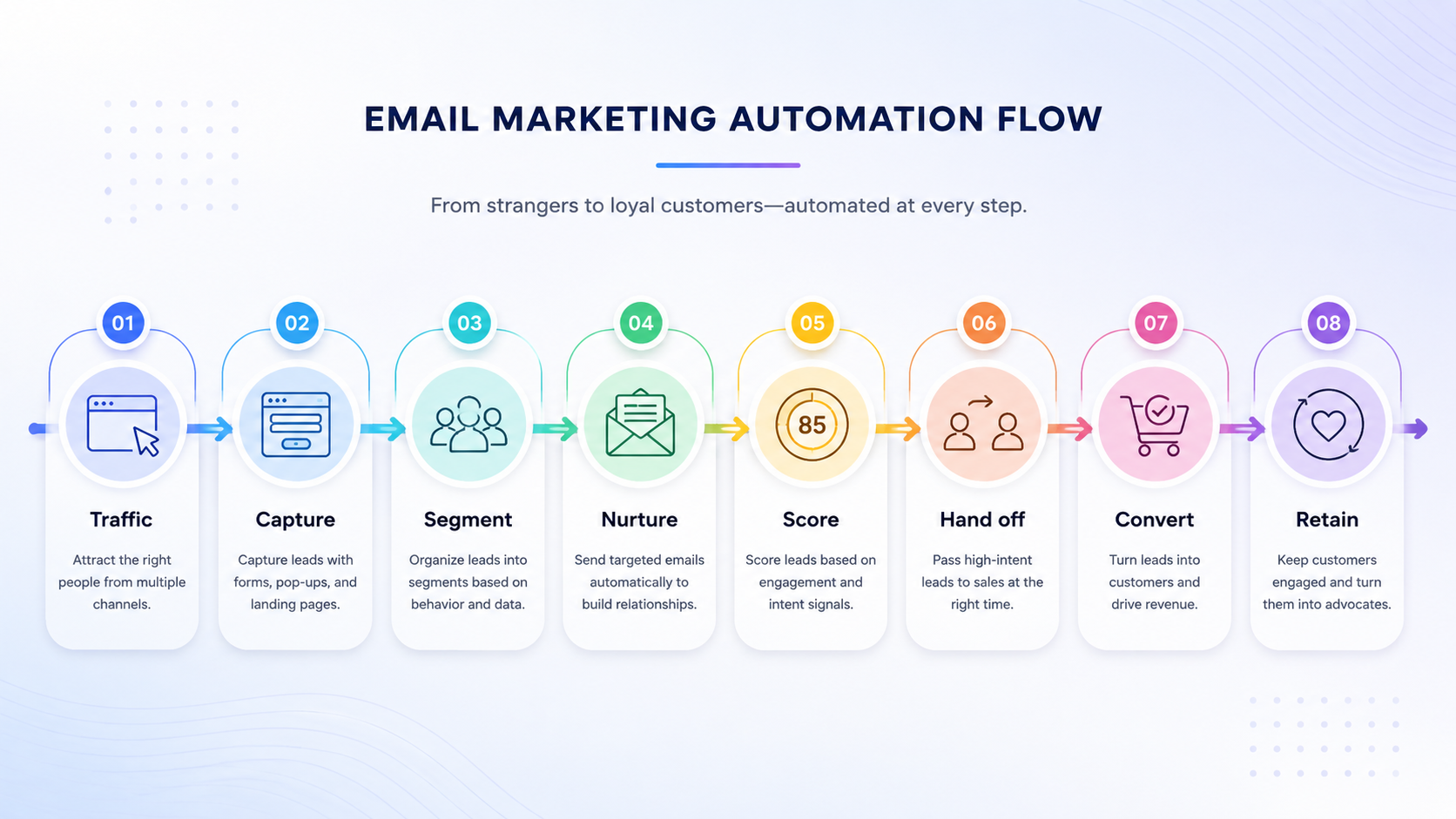
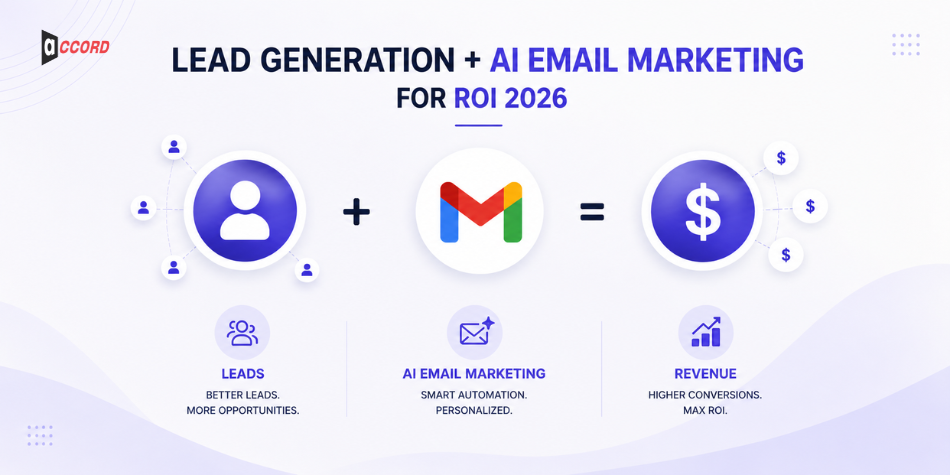
That is the architecture behind serious email automation services. Without it, automation becomes noise at scale. This is also why combining lead generation with AI email marketing creates such a strong ROI loop — the two systems feed each other when properly connected.
Why deliverability and inbox placement optimization are not optional
This part is often skipped because it is less glamorous than AI. That is a mistake.
You can have excellent copy, smart workflows, and the best email marketing software on the market.
If mailbox providers do not trust your domain, a large share of your mail can miss the inbox. GetResponse cites data showing that 16.9% of emails bounced or landed in spam in one benchmark summary, which is a reminder that deliverability loss is not a small edge case.
Inbox placement optimization usually includes:
SPF, DKIM, and DMARC setup
domain reputation monitoring
complaint-rate control
list hygiene
unsubscribe compliance
warm-up discipline
send-frequency management
audience suppression rules
Google's sender guidelines explicitly recommend SPF and DKIM authentication and warn that unauthenticated mail can be marked as spam or rejected.
That is not theory. That is operational reality.
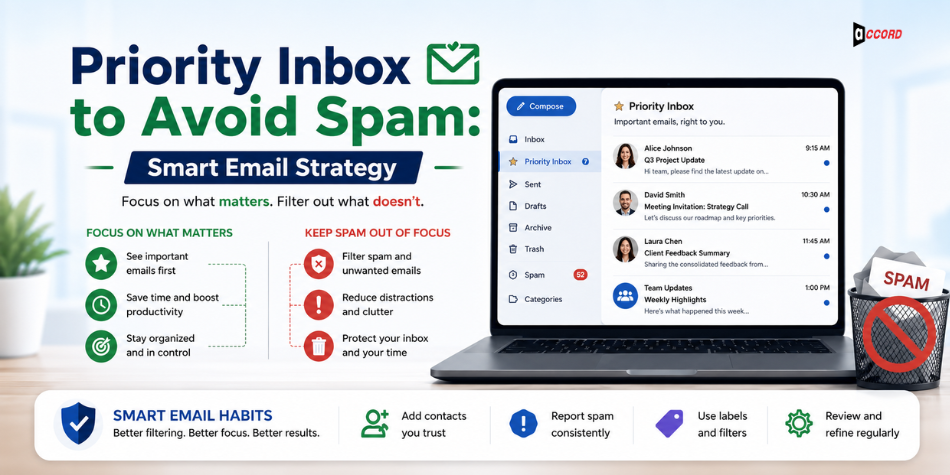
So when people ask how to improve email open rates, the answer is not only "write better subject lines." Sometimes the first fix is domain health. The guide on using predictive intent to avoid spam and reach the priority inbox explains how the newest inbox filtering logic works and what it means for campaign planning.
A realistic example
Imagine a B2B software company in Texas offering demos for mid-market operations teams.
Before automation, the team sends one newsletter a week and a monthly promo. Leads from webinars, pricing-page visitors, existing customers, and cold subscribers all receive nearly the same email.
Sales complains that leads are weak. Marketing complains that sales follows up too slowly.
Now the company rebuilds the program using email marketing automation tools and a tighter journey:
webinar leads enter a 5-part educational nurture
pricing-page visitors get a comparison sequence
demo no-shows receive a short follow-up path
inactive leads move into re-engagement
existing customers get product education and expansion content
This is where how email automation increases ROI becomes very concrete. The company does not need more sends. It needs more relevance.
Better routing, cleaner timing, and CRM-driven context usually create more efficient revenue than just sending more campaigns.
What to look for in email marketing software and agency execution
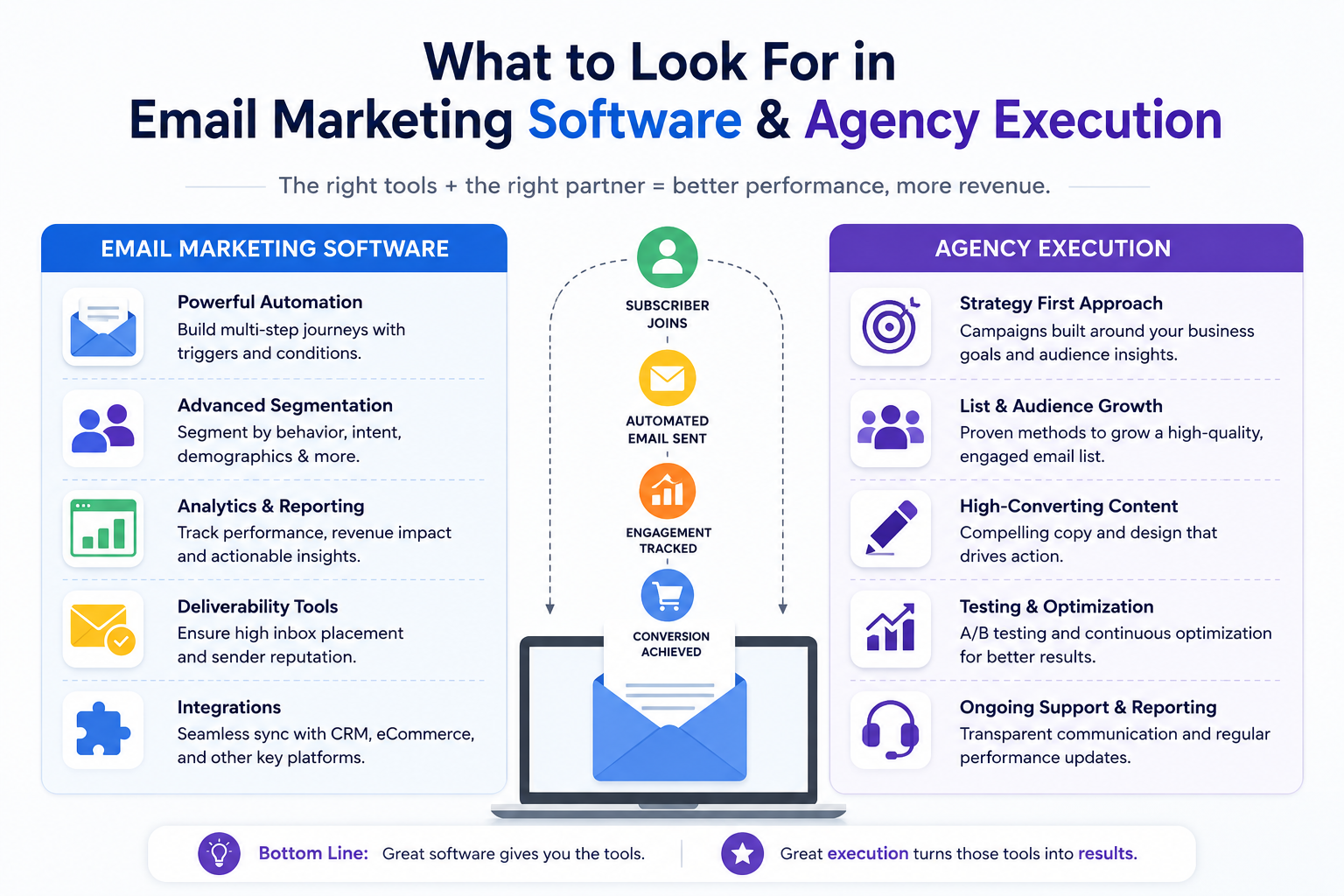
Software matters, but it is rarely the whole answer. 2026 guide focuses on use case, team size, integrations, AI fit, and automation depth when choosing platforms. That is a sensible framework.
If you are evaluating providers, look for three layers.
1. Ability to handle workflows
Can the platform handle branching logic, event triggers, suppression rules, tracking revenue, and journeys with more than one step?
2. Connecting to data
Does it let you automate CRM, set up web events, map lead sources, and sync audiences?
3. Operations for deliverability
Can the team manage domain health, complaints, unsubscribe behavior, and inbox placement optimization?
This is where a strong email marketing agency in USA can add real value. The agency should not only know the platform. It should know the business logic behind the platform.
Common misconceptions
"Automation makes emails feel robotic"
It can, if the workflow is lazy. But automation itself is not the problem. Irrelevant messaging is.
"AI can replace strategy"
Not really. AI can help with scoring, prediction, drafting, and analysis. It still needs guardrails, brand judgment, and sound segmentation.
HubSpot's own reporting on AI challenges shows that poor outputs and lack of AI knowledge remain real issues.
"Open rate is the main KPI"
Open rate still matters directionally, but privacy changes have made it less reliable on its own. Benchmarks should be read with caution, and click quality, conversions, and revenue influence often matter more. Understanding why emails aren't getting replies in 2026 helps separate the real performance signals from the misleading ones.
Best email marketing strategies 2026 for U.S. brands
The strongest strategies this year are not flashy. They are disciplined.
Build flows around buyer intent, not calendar pressure.
Use email list segmentation early, not after performance drops.
Combine AI email marketing with human review.
Tie journeys to sales stages through CRM automation.
Treat deliverability as infrastructure.
Audit inactive contacts often.
Create role-specific messaging for B2B.
Use content offers and product education to earn replies, not just clicks.
Accord Tech Solutions' public blog library shows they are publishing around AI in email marketing, automation implementation, engagement, and B2B growth, which aligns with these broader market priorities. For teams that also use cold outreach, the guide on why cold emails still work in 2026 and what to stop doing covers the same intent-first principles applied to outbound sequences.
Insight Box
Based on Accord Tech Solutions' public service and blog content, their positioning around email focuses on targeted campaigns, automation, analytics, list management, and AI-assisted personalization.
That suggests a useful agency model for U.S. businesses: do not treat email as a design project alone.
Treat it as a connected revenue system supported by data, segmentation, and operational discipline.
When to bring in an email marketing agency
You usually need help when one or more of these are true:
your list is growing but revenue per send is flat
your team uses tools but has no journey strategy
sales and marketing data do not connect cleanly
your automations exist, but nobody trusts the reporting
deliverability issues keep showing up
you need U.S.-market execution with compliance awareness
At that point, an email marketing agency is not just outsourcing. It is often a way to speed up a system that has become too fragmented internally. For businesses also looking to combine email with SEO to grow their qualified lead base, the guide on how to combine SEO and email marketing for more qualified leads is a natural next step.
Conclusion
The best email marketing automation services in 2026 are not about sending more emails. They are about sending fewer wrong ones.
That means better segmentation, stronger workflow logic, cleaner CRM signals, thoughtful use of AI, and disciplined deliverability practices.
Businesses that get this right tend to see email as more than a communication channel. It becomes a conversion engine, a retention layer, and a way to protect marketing efficiency when other channels become expensive.
If you are reviewing providers, look for a partner that understands email marketing services, email automation services, data architecture, and inbox performance together. That is the difference between activity and measurable progress. Accord Tech Solutions email marketing services are built around exactly that combination.
Executive summary
The core benefit is simple: move from manual, broad sending to intelligent, behavior-driven messaging that improves relevance and revenue.
The real USP is not AI alone. It is the combination of strategy, segmentation, automation, CRM sync, and deliverability control.
Accord Tech Solutions' public material suggests capability in targeted campaign design, automation, analytics, and AI-supported personalization, which is the right direction for businesses that want a more mature email program.